
Sakori
Sakori, privately called Cori, is a fictional warrior, field commander, prince and protector in the Tribal Universe. Created by Tony James Nelson II, writing as Tribal Brown, he first appeared in Tribal Bloody Beginnings: The Rise of the Dark Alpha and is the first-person protagonist of Sakori: Son of the Dark Alpha, the second novel in the Children of the Dark Alpha series.[1][2]
Born in the livestock settlement of Vhar’Kori on Murder Island, Sakori is nine when the expanding Ka’Rukan Empire destroys his home and kills his family. He is tied to a stake, forced to watch the settlement being emptied and then taken to Khar’Rukan in chains. His refusal to submit—including spitting at the conqueror he knows as the Dark One—persuades the Dark One to keep and train him. Utrea later calls him Cori and publicly claims him as her son without asking him to forget the people Ka’Rukan killed.[3][4]
Sakori grows into one of the founding Red Heirs, marries the Halvek survivor Yanna through Blood-Law and is named Prince of Gia after Utrea wins its Calling. The eponymous novel ends with Yanna missing and Sakori leaving Murder Island without her; the route from the island to Gia is not disclosed. In later stories, Sakori becomes Gia’s principal battlefield protector. Tribal Comics Issue 4: Assault on Gia – Sakori’s Fury centers on his defense of the kingdom against forces led by the Dark Alpha.[5][6][7][8]
Sakori’s defining conflict is not whether he can survive pain, but what survival allows him to become. His Fury opens his Ka’ru unusually quickly, yet the story treats Fury and Ka’ru as separate: Ka’ru is the energy available to him, while Fury is an emotional gate capable of raising that energy faster than his judgment can control it. His strongest victories come when he uses power to protect; his greatest failure comes when rage turns a rescue into a massacre.[9][10]
Spoiler warning: The following section contains plot details that may reveal important story events.
Canonical identity
Sakori belongs to two families whose histories cannot be separated. He is the biological son of an unnamed Vhar’Kori couple and the brother of Jarek and Kalen. He later becomes Utrea’s claimed son and accepts the Dark One as a father, while Kavumo and Zuberi also occupy important paternal roles. None of those later bonds alters his biological parentage or excuses the destruction of Vhar’Kori.
The names the Dark One, Conri, Alpha and the Dark Alpha refer to the same character in the stories relevant to Sakori. They are not separate fathers or trainers. Sakori most often calls him the Dark One while narrating his childhood, accepts “Father” during adolescence and later rejects the idea that Conri was his father “in every way that matters,” identifying Kavumo instead. The change reflects the damage and evolution of their relationship rather than a change in biological fact.[9][1]
| Matter | Established canon | Important limit or qualification |
|---|---|---|
| Birth and capture | Sakori is from Vhar’Kori and is nine when Ka’Rukan destroys it. | His birth date and surname are not stated. |
| Biological family | His parents and brothers Jarek and Kalen die during the conquest. | The parents’ personal names are not given. |
| Utrea | Utrea gives him the name Cori and publicly claims him as her son. | She is not his biological mother. |
| The Dark One | The Dark One kills Sakori’s birth father, captures Sakori, trains him and later becomes a father by Sakori’s choice. | He is not Sakori’s biological father, and Sakori later disputes whether he truly fulfilled fatherhood. |
| Kavumo and Zuberi | Both become paternal teachers. Adult Sakori identifies Kavumo as the person who was truly his father. | Neither is his biological father. |
| Yanna | Yanna is Sakori’s voluntary Blood-Law wife and a member of his claimed family. | Her disappearance is unresolved; no confirmed body or death is established. |
| Gia | Sakori is named Prince of Gia after Utrea wins the Gia Calling. | He is not Gia’s Alpha or king; Utrea is its queen. |
| Latest status | Sakori survives the assault on Gia and later continues the mission involving Reonniz. | His ultimate fate is not revealed. |
Names and titles
Sakori
Sakori is his birth name and the part of Vhar’Kori that his captors cannot take from him. His father dies saying it, and Sakori gives it to the Dark One only after deciding that refusing to speak would allow the conquerors to take one more thing. No surname, clan name or separate dynastic name has been revealed.[3]
Cori
Cori is the “mother-name” Utrea creates when Sakori is eleven. He first objects that the shortened form is not his name, then cannot bring himself to ask her to stop. For a long period only Utrea uses it. Yanna later learns and uses the name because it identifies the protected, intimate self beneath Sakori’s public defiance.[4][11]
Captive heir and Red Heir
“Captive heir” is a former insult, not an accepted title. When a visiting warrior uses it, Utrea places a blade to his throat and declares Sakori her son. The later title Red Heir emerges during the campaign against the Root-Eaters, when Sakori, Rim, Eshari and their companions become recognizable as the young fighting generation beneath Ka’Rukan’s red banners.[4][11]
Prince and protector of Gia
The keeper of Gia’s Calling formally names Sakori Prince of Gia and Rimitorry Princess of Gia after Utrea’s victory. “Protector of Gia” describes his later battlefield role, especially during the coordinated assault depicted in Tribal Comics Issue 4. The titles are distinct: prince is a confirmed royal designation, while protector describes what he does.[5][6]
The boy who spat in his face
Sakori’s best-known personal description comes from his first act of resistance against the Dark One. In later confrontations he identifies himself as the boy who spat in the conqueror’s face and lived. The phrase turns childhood powerlessness into a declaration that defeat never gave the Dark One ownership of him.
Fictional biography
Vhar’Kori
Sakori is born in Vhar’Kori, a pastoral community known for cattle, goats, grain and durable horses. Its people are hunters, herders and tradespeople rather than a standing warrior society. They usually survive raiders by surrendering enough food or livestock to make further violence unprofitable. Sakori’s childhood includes his parents, his brothers Jarek and Kalen, other village children and a calf named Muro. He also learns the settlement’s rain song, which later becomes his clearest remaining cultural inheritance.[3]
Nim’Raza arrives ahead of the Ka’Rukan founders and quietly inventories the settlement’s animals, buildings, skilled workers, roads and storage. When the other founders reach Vhar’Kori, she recommends taking all of its resources to expand Khar’Rukan’s walls, roads, granaries, barracks, forges and intelligence network. The village elder offers tribute instead, but the Dark One asks what will happen if Ka’Rukan takes everything. The answer—that the village will die slowly—makes the nature of the demand clear.
Vhar’Kori resists with farm tools and hunting weapons. The Dark One kills Sakori’s father; Utrea kills Kalen; Knargz strikes Jarek; and Sakori’s mother is killed after hiding him behind a cart. His dying father says only Sakori’s name. The attackers seize the settlement’s animals, food, tools, weapons and labor while its buildings burn.
After Sakori is found, the Dark One asks his name. Sakori spits in his face and promises to kill him. Instead of executing the child, the Dark One recognizes his defiance and orders that he be taken. Sakori is tied to a stake for hours while Vhar’Kori is emptied, then chained for the march. He refuses to walk and is dragged away.[3]
Through the black gates
Khar’Rukan is more organized than the den of monsters Sakori expects. Its children attend school, work, train and learn practical subjects; its teachers, healers, farmers and craftspeople include specialists taken from conquered communities. Physical labor doubles as preparation for adult service. The city’s structure forces Sakori to confront a difficult truth: the people who destroyed his home are building a functioning society for the children closest to them.[12]
At the palace steps, the Dark One admits that he is a monster and tells Sakori to become strong enough if he still intends to kill him. Sakori refuses Utrea’s offered hand but walks inside under his own power. He meets Rimitorry and Eshari, attempts to escape that night and threatens Utrea with a stolen knife. Rather than demand forgiveness, Utrea corrects his grip and replaces the poor weapon with a better one. Her care confuses him because it exists beside her admitted responsibility for Vhar’Kori.
Training under the six founders
Although outsiders’ stories call the group “the Five,” Sakori recognizes six adults holding independent authority at Khar’Rukan: the Dark One, Utrea, Kavumo, Knargz, Zuberi and Nim’Raza. Each trains a different part of him.
| Teacher | Principal lesson | Effect on Sakori |
|---|---|---|
| The Dark One | Rage must be shaped; losing a fight is not the same as giving oneself away. | Sakori learns to retain identity under defeat and later to direct Fury instead of merely releasing it. |
| Utrea | Grief, memory and love are not weaknesses. | Sakori is allowed to mourn Vhar’Kori while belonging to a second family. |
| Kavumo | Balance, falling, impact and recovery. | His ability to rise after devastating injuries begins with learning how to fall correctly. |
| Knargz | Pain tolerance and continued thought under injury. | Sakori learns to function while hurt rather than treating pain as the end of a decision. |
| Zuberi | Strategy, logistics and impossible choices. | Sakori learns that command requires names, information and responsibility for lives—not merely victory. |
| Nim’Raza | Concealment, breath, hidden Ka’ru and unreadable intent. | Sakori learns that power revealed too early tells an enemy where to strike. |
Nim’Raza openly admits scouting Vhar’Kori and refuses to apologize. She is also the first teacher to identify Sakori’s unusual pattern: anger makes his Ka’ru climb faster than most. Her instruction is not to eliminate the rise but to control it.[12]
Utrea’s claim
By eleven, Sakori has lived in Khar’Rukan for almost two years. Familiar routines and bonds with Rim, Eshari, Polezah, Nahla, Kovi, Sura and Veyu make the capital increasingly difficult to hate as a single thing. Utrea begins calling him Cori while caring for an injured Kavumo. She also sits with him when the rain restores pieces of Vhar’Kori’s song and tells him that no one will require him to stop loving the dead.
During a feast, a visiting warrior calls Sakori a captive heir. Utrea moves before Sakori can attack, holds a blade to the visitor’s throat and states that Sakori is her son. She then offers Sakori her hand in front of the court. Unlike at the palace entrance, he takes it and sits beside her at the high table. The claim gives him public protection and family standing, but the novel presents his acceptance as coexistence with his first family rather than replacement of it.[13]
Zafira and the Root-Eaters
At thirteen, Sakori watches the Dark One return from another destroyed settlement carrying three-year-old Zafira. Her bloodstained clothing, silence and brandy-colored eyes remind him of his own arrival. Utrea claims the child immediately, but Zafira forms her strongest early attachment to Sakori. He holds her during storms, teaches her to laugh and becomes one of the few people she trusts to keep her safe.[14]
Root-Eaters later abduct Zafira from the palace grounds. Sakori, Rim, Eshari, Polezah, Nahla, Kovi, Sura and Veyu follow the trail into concealed root tunnels, kill the kidnappers and recover her before the adults arrive. Evidence that the Root-Eaters are taking children throughout Ka’Rukan’s borderlands leads the founders to place 130 warriors under the young group’s joint field command.
Sakori and Eshari take sixty fighters west while Rim leads seventy south. The campaign forces Sakori to learn the names, families, capabilities and fears of the people under him. He begins to understand that command is not permission to spend unnamed lives. His force reaches Halvek during a Root-Eater attack and helps preserve the settlement.[15]
At Halvek, Sakori meets Yanna, a girl his own age who fights from a cart and refuses to kneel after the rescue. Halvek accepts Ka’Rukan’s protection and tribute system, but Yanna challenges Sakori’s claim that imperial law makes the settlement safe. He continues visiting her, reveals the name Vhar’Kori and admits that he now fights under the banners of the people who destroyed it. Yanna becomes one of the few people who speaks to him as Sakori rather than as an heir.
The Root-Eater campaign ends at Vosh’Kalen. After its fall, Eshari finds a blue-eyed infant beneath broken stone and carries him from the ruins; he is later named Khalembo. Of the 130 warriors who marched from Khar’Rukan, 121 return. Nine are dead, seventeen have been wounded and six rescued children travel in the guarded carts, while the newly discovered infant remains with Eshari. The campaign establishes the younger group as the Red Heirs.[15]
Fury, command and chosen fatherhood
Nim’Raza’s Calling occurs while Sakori is still thirteen. She leaves carrying her infant son Razhaku and accompanied by Sura and Va’Lira. Her departure creates another empty place in the household and leaves Sakori with her warning that Fury can open his Ka’ru but cannot be allowed to choose its purpose.[9]
Sakori then joins the Dark One, Utrea and Zuberi on a major imperial campaign. He learns to distinguish surrender from continued threat, preserve leaders who hold useful information and consider the lives behind military markers. When the force returns to Halvek, the Dark One honors the settlement’s existing agreement because it has bent, paid tribute and kept the road open. Yanna directly challenges his language of protection, and he allows her to do so.
Zuberi becomes a father through patient instruction, maps and quiet presence. Sakori’s biological father remains the man who died saying his name. The Dark One eventually acknowledges that this earlier father cannot be erased and that Zuberi’s bond does not diminish him. During a training duel, Sakori raises Ka’ru without anger and finally makes the Dark One move. He then takes the open hand he once refused and calls him “Father” for the first time. The choice does not absolve the Dark One; it means Sakori decides what the relationship will be.[9]
The destruction of Halvek
Kavumo wins Terra’s Calling and leaves when Sakori is fifteen. By sixteen, failed wells and sick children have weakened Halvek. Ka’Rukan demands six workers as part of the settlement’s obligation, but Halvek refuses. Rim leads the Red Heirs to enforce imperial law. When hidden residents make the count appear deceptive, she treats the resistance as a public challenge to Ka’Rukan’s authority.[16]
Yanna alone refuses to kneel. Sakori understands that drawing against Rim could split the Red Heirs and still fail to save Yanna, so he remains close without attacking his sister. Rim kills seventy-four people, ending with Yanna’s father, and orders Halvek burned. She explicitly frames Yanna’s survival as strategy: the girl will carry the story of what defiance costs. The narrative also implies that this explanation hides a more personal limit—Rim cannot kill the girl she knows Sakori loves.[16]
Sakori does not regard his failure to stop the massacre as innocence. He travels after the prisoner cart and finds Yanna held at Marrek’s Ford in violation of Rim’s orders. Guards have locked her in a storage room, struck her and taken the cord that belonged to her father. Sakori kills two guards after they insult her and refuse his command, restores the cord and offers her a choice instead of another claim. Yanna chooses to follow him to Khar’Rukan.
At the palace, Yanna confronts Rim and the exchange escalates into a violent fight involving Sakori and the siblings. The Dark One and Utrea stop the conflict, while Yanna prevents Sakori from continuing it in her name. The Dark One proposes marriage as a status every Ka’Rukan soldier would understand, but Yanna refuses to marry Sakori merely for protection. She is allowed to remain without accepting the proposal.[16]
Yanna and Blood-Law
Yanna first trains with Sakori and instructors she chooses independently. She does not enter the household as a passive student assigned to the people who destroyed Halvek. Only after choosing individual relationships does she voluntarily seek instruction from Utrea, the Dark One, Zuberi, Knargz, Eshari, Polezah and the other Red Heirs.[17]
Yanna later asks whether Sakori still wishes to marry her. She agrees only after defining the marriage herself: she remains Yanna of Halvek, keeps her father’s memory, chooses her work and training, and never owes Rim forgiveness. Sakori accepts each condition. Their Blood-Law ceremony joins Vhar’Kori and Halvek through a voluntary exchange of blood. It gives neither spouse ownership of the other and preserves both destroyed communities within the family they create.
Through Blood-Law, Yanna calls Utrea her blood-mother and the Dark One her blood-father. The terms are direct kinship claims under the family’s law, not “mother-in-law” or “father-in-law.” Yanna builds loving bonds with most of the household while never emotionally forgiving Rim. Their rivalry sometimes becomes humorous, but humor does not amount to reconciliation.[17]
By seventeen, Yanna has become the strongest of Khar’Rukan’s younger fighters. In a five-against-one test she defeats Rim, Eshari, Nahla, Veyu and Kovi; Sakori is not one of the five. She repeatedly surpasses Rim, but the adult Chamber survivors remain far beyond her: the Dark One defeats her in three breaths, and Utrea disarms her almost as quickly. The adults recognize a crossed-wrist turn in Yanna’s paired-sword style but initially refuse to explain why it is familiar.

The fourteen-day test and Yanna’s disappearance
By the end of another rainy season, Sakori and Yanna are eighteen. Before their Blood-Law survival test, the Dark One and Utrea give Yanna two black, blood-bound swords named No Mercy and No Surrender. The weapons answer her Ka’ru and can return to her hands within physical limits; they do not think, cross barriers or ignore exhaustion and distance. They bear no Ka’Rukan crest and belong to Yanna rather than the empire.[10]
Because Blood-Law has joined their road, Sakori and Yanna undertake the fourteen-day test together. They must leave imperial roads, invoke no family privilege and return together through the western ravine. Their route becomes a series of rescues from raiders, cannibals and the Hollow-Spear Clan.
At a ruined Hollow-Spear camp, they meet Makhera, a bannerless fighter whose paired-sword movement resembles Yanna’s. Makhera reveals that she gave birth to Yanna but rejects the idea that blood alone earns the name mother. She says Utrea gave Yanna a life and therefore gave the greater gift. Makhera also states that eight children survived the Chambers: six remained together, while she chose another road. Yanna continues to call her Makhera and reserves “mother” for Utrea.[10]
The pair later trains with Sava in an ancient temple where Murder Island’s pressure interferes less with shaped Ka’ru. Both learn rudimentary healing, heat and flame work. Yanna uses smaller, steadier amounts of energy, while Sakori’s instinct is to release more than the task requires. Their lessons emphasize that all power has a cost and that mercy is judgment exercised after victory, not weakness.
By the final day, thirty-one rescued civilians follow Sakori and Yanna toward the western marker. The pair crosses together on the fourteenth morning, apparently completing the test, but a combined force attacks the civilians and the waiting Ka’Rukan patrol. The civilians reach the shield line. Yanna is impaled through the side, and Sakori’s Fury drives his Ka’ru beyond judgment. He kills armed attackers, surrendering enemies and unarmed people attempting to flee. Yanna continues protecting him but spares people who are no longer threats.
When Yanna stands between Sakori and the final survivors, his fire strikes the ancient causeway instead. Water buried beneath the road breaks through, dividing them in collapsing stone, steam and flame. No Mercy is torn from Yanna’s hand and trapped in the causeway; Yanna disappears while still holding No Surrender. Sakori finds No Mercy but no body and returns to Khar’Rukan alone.[10]
Eshari leads a search of the river, both banks, sink rock and surviving enemy camps. The search finds no body, no No Surrender and no verified witness to Yanna’s fate. The Dark One refuses to place a death stone and declares her missing. Later rumors describe a northern resistance leader called the Ash Girl and sometimes identify her as Yanna, but no witness confirms her face or paired swords. The story therefore leaves her survival unresolved rather than establishing either death or return.
Utrea’s Calling and departure for Gia
Rim completes her own wilderness test after the search for Yanna. She returns alive but admits that she hunted people beyond what survival required, revealing a growing hunger for Ka’ru. The first horn for Gia sounds while the family is confronting what the test awakened in her.[5]
Utrea’s response to Gia’s Calling forms part of the founders’ long-term plan to move their family beyond Murder Island. Before entering, she claims Rim by birth and offers Sakori a place by choice. Sakori accepts. Utrea also demands to take Eshari, but the Dark One insists that Eshari remain to help protect Zafira, Khalembo and Khar’Rukan. Their dispute becomes physical and draws in Knargz and Zuberi, yet it cannot change the Calling’s law or the names already placed under Gia’s protection.[5][18]
One hundred fighters enter the Gia Calling: Utrea and ninety-nine opponents. Alliances and outside help are forbidden, and victory belongs to the final person able to stand. Utrea personally kills seventy opponents while the remaining candidates kill one another. Every opponent dies. After Utrea defeats the final spearwoman, she stands alone and sits on the mound of bodies. The keeper recognizes Utrea as queen, Rim as Princess of Gia and Sakori as Prince of Gia.[5]
Before leaving, Sakori gives No Mercy to Eshari and orders her to return it to Yanna if Yanna comes home and to let no one else carry it. No Surrender remains missing with Yanna. Sakori leaves Murder Island with Utrea and Rim; Eshari, Zafira, Khalembo, the Dark One, Knargz, Zuberi and the remaining Red Heirs stay behind. The novel does not describe the means or route by which the three travel from Murder Island to Gia. It ends with Sakori crossing out as prince without Yanna’s body, hand, sword or answer.[5]
Life in Gia
Sakori becomes part of Utrea’s royal household and the defense of Gia. He is not described as the kingdom’s Alpha. His confirmed position combines dynastic status with practical service as:
- Prince of Gia;
- Utrea’s claimed son;
- an elite field warrior;
- a protector of the royal family;
- the kingdom’s most prominent individual defender during the later invasion.
His life in Gia includes continued training, war involving Gia and Nebu, knowledge of the Gia pages of the Tribal Bible and efforts to preserve a family divided between territories and loyalties. The absence of a disclosed travel method in Sakori: Son of the Dark Alpha should not be filled with an invented ship, portal or route.
Assault on Gia
Approximately thirteen years after the departure from Murder Island, the Dark Alpha coordinates a multi-front attack on Gia. Zuberi advances against the eastern flank with five hundred human NEBU warriors; Deathwave attacks from the west; three Harpies climb the southern cliffs; and Alpha enters through the main gate for Utrea. Sakori moves between fronts rather than commanding from a throne, becoming the kingdom’s primary battlefield protector.[19][6]
Zuberi
Sakori approaches Zuberi alone and initially asks his former teacher to leave. When Zuberi refuses, their duel becomes a test of lessons remembered from childhood. Sakori changes rhythm after several minutes, cuts Zuberi’s thigh, attacks behind the knee and brings him down. He refuses to kill him and sends him back with a warning that the boy Conri spared learned how to stand.[6]
Deathwave and the Harpies
At the western approach, Sakori concludes that Deathwave was constructed and conditioned as a weapon without being fully trained as a warrior. He catches one of Deathwave’s blades with his bare hand, breaks his arm, lifts him by the throat and throws him through a stone wall, leaving him alive.
Sakori next confronts three Harpies at the southern wall. Because he has studied their group tactics, he predicts that two will die and urges them to run. He kills two, spares Zinetha and sends her away as a witness. He then carries the two severed heads to Alpha at the main gate.[6]
The Dark Alpha
Sakori identifies himself to Alpha as the boy who spat in his face and lived. Although he is already wounded from the earlier fronts, his controlled Fury raises his speed, strength and precision. Alpha progressively calls out higher fractions of his own power, reaching seventy percent during the duel; Sakori later believes the actual peak was higher.
Sakori repeatedly wounds Alpha and places the point of his sword into Alpha’s chest near the heart. He hesitates rather than complete the killing stroke because Alpha remains part of the family that shaped him. Alpha exploits the wound behind Sakori’s knee, destroys his balance and knocks him unconscious with the hilt of his sword. He calls Sakori his firstborn and strongest child, but the scene does not function as an objective ranking of every family member’s maximum power.[19][6]
Reunion with Khalembo
After the duel, Khalembo finds Sakori catastrophically wounded but standing again. He calls his older brother magnificent and “the strongest of us all,” responding especially to Sakori’s endurance through Zuberi, Deathwave, the Harpies and Alpha. Sakori remembers Khalembo as a three-year-old child who held his shirt until someone picked him up. He reveals that he held Khalembo for an hour on the night before leaving Murder Island but did not wake him because saying goodbye might have made Sakori stay.
Khalembo admits that he kept waiting after the departure and that no one picked him up again. The brothers discard their weapons and embrace. Because Alpha is watching, Sakori then helps Khalembo stage a convincing fight so the younger brother can preserve his cover. Khalembo uses real force while avoiding fatal targets and ends by striking beside Sakori’s head. The deception allows love and apparent loyalty to coexist until Khalembo is ready to choose openly.[19][6]
Protecting Utrea
After Khalembo’s staged fight, Alpha battles Utrea and Kavumo. Sakori has already fought across every front and can barely move. When Alpha raises his sword toward Utrea, Sakori rises once more and puts himself between them. Alpha’s blade passes through his chest. Sakori tells Utrea to run before collapsing.
The act defines his role as protector more clearly than any political title. Sakori does not interpose himself because he owns Gia; he does it because Utrea is his mother, the kingdom’s queen and the person behind him. Later events establish that he survives. His recovery is accelerated but incomplete, progressing over weeks from supported movement to holding a blade and training again.[19][6]
Reunions with Zafira and Eshari
Zafira initially presents herself as loyal to Conri and challenges the returning family members. Sakori asks her to prove that loyalty by fighting him, but she cannot. She remembers him as the older brother who held her when she cried, taught her to laugh and made her feel safe after she was brought to Khar’Rukan. Their reunion confirms that the child who trusted Cori remains present beneath Zafira’s adult violence.[1]
Eshari confronts the siblings who left Murder Island and believes Utrea chose Rim and Sakori without fighting for her. Sakori does not treat her anger as ignorance that can be dismissed. He reveals the confrontation he witnessed before Gia’s Calling, when Utrea demanded to take Eshari and the Dark One refused. The information changes the meaning of Utrea’s departure without undoing Eshari’s thirteen years of separation.
Later mission
Sakori steals thirteen pages associated with Gia’s portion of the Tribal Bible, later giving Thirty-Two access to additional spells. He joins Rimitorry, Eshari, Zafira and Thirty-Two on a mission toward Terra to reach Reonniz before the Dark Alpha can control him. During this later period Sakori sharply rejects Conri as his true father and identifies Kavumo instead, showing how the assault and the family’s continuing violence have altered the acceptance he once offered as a teenager.[1]
Relationships
| Character | Relationship with Sakori | Canonical qualification |
|---|---|---|
| Yanna | Sakori’s partner and wife under Blood-Law. They meet at thirteen, choose marriage after Halvek’s destruction and undertake their survival test together. | Yanna does not become his property, abandon the name Halvek or forgive Rim. She remains missing rather than confirmed dead. |
| Utrea | His claimed mother, the creator of the name Cori and the person who publicly gives him a place beside her. He later leaves Murder Island under her successful Gia claim. | She helped destroy Vhar’Kori and never claims biological motherhood or demands forgiveness. |
| The Dark One | His captor, trainer, adoptive father and later battlefield opponent. Sakori chooses to call him Father as a teenager. | The Dark One killed Sakori’s birth father. Adult Sakori later rejects him as his true father and names Kavumo instead. |
| Kavumo Dlamini | An early teacher who shows Sakori how to fall, recover and remain stable. Adult Sakori describes Kavumo as the man who was always his father. | This is chosen fatherhood, not biological descent. |
| Zuberi Ka’ Nalo | Strategist, commander, teacher and paternal presence. He teaches Sakori to think in names, resources and consequences. | They later fight on opposing sides at Gia; Sakori defeats and deliberately spares him. |
| Rimitorry Ka’ Tora | Sakori’s claimed sister, fellow Red Heir and Princess of Gia. They grow up, campaign and leave Murder Island together. | Rim’s killing of seventy-four people at Halvek permanently wounds the relationship and makes her Yanna’s unforgiven enemy. |
| Eshari | His observant sister, trusted field partner and co-commander. She finds Khalembo, leads the search for Yanna and receives No Mercy for safekeeping. | Sakori later carries the truth that Utrea fought to take Eshari from Murder Island before the Gia Calling. |
| Zafira | His younger sister and one of the first children to call him Cori after Utrea. He becomes her principal childhood source of safety. | Her later violent identity does not erase her inability to treat him as a disposable enemy. |
| Khalembo | His younger brother, found as an infant after Vosh’Kalen. Sakori’s departure becomes one of Khalembo’s formative wounds. | Their later fight is staged to conceal Khalembo’s emotional rebellion from the Dark Alpha. |
| Polezah | His healer brother and fellow early palace child. Polezah treats injuries, studies Ka’ru and often exposes wounds Sakori tries to hide. | Their methods differ: Sakori protects through presence and endurance, while Polezah relies on medicine, experimentation and control. |
| Reonniz | A hidden biological son of Conri and Utrea whom Sakori regards as a brother. Sakori seeks to reach him before Conri can control him. | Much of their relationship is prospective because separation prevents them from growing up together. |
| Nim’Raza | One of his earliest teachers and the scout responsible for selecting Vhar’Kori’s resources for conquest. | Sakori never receives an apology; her honesty about responsibility becomes part of his understanding of the adults who raised him. |
| Knargz | A teacher whose brutal humor and pain training contribute to Sakori’s endurance. | Their bond combines resentment, affection and reluctant admiration. |
Yanna
Yanna is the most important relationship created within Sakori’s eponymous novel. She sees him first as the representative of an empire demanding submission, then as a boy who remembers another destroyed home. Sakori loves her before Halvek falls, but love does not allow him to claim innocence when his sister kills her people. Yanna similarly chooses Sakori without treating that choice as forgiveness for Ka’Rukan.
Their marriage depends on repeated consent rather than rescue. Yanna first rejects the proposal made for her safety and remains in Khar’Rukan without marrying. She later initiates the question herself and states the conditions under which she will agree. Blood-Law protects her politically, but the relationship is legitimate because she has already proved that refusal will be respected.[20]
The two develop contrasting methods of power. Sakori’s energy can climb explosively through Fury; Yanna compresses Ka’ru close to her body and blades, spends less and maintains control longer. Their partnership works best when each corrects the other’s weakness. It fails at the Red Ash causeway when Sakori’s output becomes so large that he no longer accepts Yanna’s judgment until she physically stands in his path.
Sakori’s final act concerning Yanna in the novel is not to keep her surviving sword. He gives No Mercy to Eshari because it belongs to Yanna and should be waiting if she returns. This distinguishes grief from ownership and leaves Sakori’s marriage unresolved rather than ended.
Utrea
Utrea is Sakori’s strongest maternal bond. She stops a warrior from striking him during the march, gives him a knife worth carrying, tends his wounds, allows him to hate her and protects his memories of Vhar’Kori. Her public declaration that he is her son changes his legal and political position, but the private name Cori establishes the relationship before the court does.
Sakori later comforts Utrea over the family members she could not save or take with her. He also becomes the body between her and Alpha’s sword at Gia. Their bond therefore moves from Utrea protecting a furious child to Sakori protecting his mother and her kingdom.
Fathers
Sakori’s story treats fatherhood as plural, chosen and unstable.
- His unnamed birth father dies at Vhar’Kori after the Dark One strikes him down. His final word is Sakori’s name.
- The Dark One kills that father, captures Sakori and becomes the principal authority training him. Sakori eventually accepts him as Father, then later withdraws the emotional title.
- Kavumo teaches Sakori bodily trust, balance and recovery. In adulthood Sakori says Kavumo was the person who was truly his father.
- Zuberi fathers through strategy, attention and patience. His importance is not erased when Sakori accepts the Dark One’s hand.
The relationships are not interchangeable. Acknowledging one does not retroactively remove another, and none changes Sakori’s biological ancestry.
Rimitorry
Rim is one of Sakori’s oldest palace relationships. They progress from hostility at the black gates to ordinary sibling intimacy, joint command, shared guilt and eventual royal status in Gia. She is also responsible for the act Sakori cannot make harmless: the destruction of Halvek.
Sakori does not fight Rim during the massacre because he believes doing so could divide the Red Heirs, widen the killing and still leave Yanna trapped. The choice is tactical but not morally clean. Afterward, he refuses to speak to Rim, rescues Yanna from guards and opposes anyone who treats Halvek as an insult. Their sibling love survives, but it no longer permits Sakori to pretend that Rim’s power is protective simply because she calls it law.
Eshari, Zafira and Khalembo
Eshari, Zafira and Khalembo reveal three forms of Sakori’s role as an older brother. Eshari is his equal and trusted watcher; Zafira is the frightened child he helps feel safe; Khalembo is the child whose abandonment Sakori cannot undo. He later gives Eshari the evidence of his continuing hope for Yanna, prevents Zafira from reducing herself to a weapon and helps Khalembo conceal a rebellion he is not yet ready to make public.
Appearance
The novels emphasize Sakori’s movement, posture, scars and injuries more often than a fixed catalog of features. As a child he is repeatedly shown chained, bruised, split-lipped or bleeding while refusing to lower his gaze. The first-person narration does not establish a surname, exact adult height or a complete permanent description.
Official comic depiction
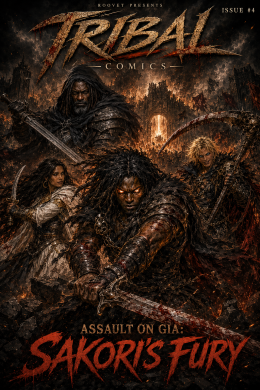
The official Tribal Comics Issue 4 artwork depicts Sakori as a dark-skinned, heavily muscled and scarred adult with long black hair, dark armor, a heavy cloak or fur-lined covering and a large sword. His eyes glow with magma-like orange, red and white energy when Fury drives his Ka’ru upward. The adaptation provides his most prominent published visual design, although individual artistic details may vary in later depictions.[6]
Personality
Sakori is defiant, protective, observant, compassionate, angry and unusually persistent. His characterization depends on contradictions he refuses to simplify: he can love people who helped destroy his home, serve an empire whose language he questions, protect a sister whose actions he condemns and choose a father before later deciding that the title was not earned permanently.
Defiance is his earliest survival mechanism. He spits at the Dark One, fights restraints, refuses to yield during training and returns after defeats. As he grows, defiance develops from uncontrolled reaction into the ability to retain his own judgment beneath stronger people and systems.
Protection is his preferred use of strength. He chooses a child when Zuberi gives him an impossible rescue problem, then insists he will save the wounded fighter as well. He holds Zafira, preserves soldiers whenever he can, offers Yanna choices, spares Zuberi and Deathwave, protects Khalembo’s secret and finally takes a sword meant for Utrea.
Compassion does not make Sakori harmless. He can kill decisively and, during the final test, kills people who are no longer threats. The narrative treats that massacre as failure rather than a higher form of protection. Yanna’s willingness to stand against him becomes evidence that love must include restraint.
Memory prevents his second family from erasing the first. Sakori keeps Vhar’Kori’s name and rain song, remembers his father’s last word and joins his blood to Yanna without requiring either Halvek or Vhar’Kori to disappear. He also carries memories that other family members lack, including Utrea’s fight to take Eshari and Khalembo’s need to be held.
Guilt follows the people he cannot save. Sakori blames himself for standing beside Rim at Halvek, leaving younger siblings behind and returning without Yanna. His better responses turn guilt into responsibility; his worst response lets fear of another loss feed Fury until he creates more victims.
Dry humor develops as Khar’Rukan becomes home. His arguments with Rim, Yanna, Polezah, Knargz and the other children prevent the family story from becoming emotionally one-note. The humor expresses intimacy, but it never cancels the violence beneath their shared history.
Ka’ru and Fury
Ka’ru is the living energy or power capacity carried within a person. It can be directed into strength, speed, perception, endurance, recovery, weapon work and shaped effects. A higher level means more energy is available, while training and control determine how efficiently it is used.
Fury is not a second name for Ka’ru and is not the energy’s source. It is Sakori’s emotional gate. Anger, fear and protective urgency can make his Ka’ru rise with exceptional speed, allowing him to access more of what he already possesses. The danger is that the rise can outrun judgment. Nim’Raza identifies the pattern; the Dark One teaches direction; the temple lessons expose its inefficiency; and Yanna’s disappearance follows Sakori’s failure to close the gate after the immediate danger has changed.[9][10]
Sakori also learns to raise Ka’ru through calm intention. During adolescence he makes the Dark One move without using anger, and at the temple he creates a controlled flame by concentrating on warmth rather than rage. These moments prove that Fury is an accelerator, not a requirement.
Yanna provides the clearest contrast. Her Ka’ru rises by decision, stays compressed and accomplishes more with less released energy. At points her resting level may be higher while Sakori’s maximum rises faster. The novels therefore avoid treating “stronger” as a single permanent statistic.
Limited energy shaping
Under Sava, Sakori learns the beginnings of:
- touch-based healing;
- generating a small flame;
- moving heat without visible fire;
- sensing water without direct contact;
- recalling energy before a shape consumes more than intended.
Murder Island resists or consumes shaped effects, increasing their cost outside protected spaces. Sakori remains a beginner in these disciplines, and they should not be described as limitless magic or effortless regeneration.[10]
Abilities
Extreme endurance and pain tolerance
Sakori’s defining physical trait is his ability to remain functional after severe injury. Kavumo teaches safe impact and recovery, Knargz teaches thought under pain, and repeated combat strengthens both body and Ka’ru. Endurance does not make him invulnerable; he bleeds, loses mobility, becomes unconscious and requires recovery.
Swordsmanship
Sakori is an elite swordsman capable of confronting Root-Eaters, organized raiders, senior Ka’Rukan teachers, altered weapons and supernatural opponents. His style combines the six founders’ lessons: direct pressure, recovery, concealed changes of rhythm, tactical observation and the willingness to keep fighting after damage.
Strength and speed
Ka’ru allows him to strike, lift and move far beyond ordinary human limits. Confirmed feats include breaking Deathwave’s arm, throwing him through a stone wall, threatening Alpha at high output and crossing multiple fronts after already being wounded.
Rapid recovery
Sakori heals faster than an ordinary human, particularly after later high-level battles. Recovery still takes time and carries pain, weakness and incomplete function. His survival of a sword through the chest is extraordinary even within the setting.
Command and strategy
During the Root-Eater campaign, Sakori learns to lead named people rather than abstract pieces. He uses terrain, deception, restraint and information. The staged fight with Khalembo is one of his clearest strategic successes because it protects Khalembo’s life, cover and future choice simultaneously.
Tracking and survival
Training in Khar’Rukan and the fourteen-day test give Sakori experience with trails, hidden positions, wilderness movement, rescue logistics and improvised defense. He can continue guiding civilians while injured and deprived of official support.
Concealment
Nim’Raza trains Sakori to control breathing, cross ash without visible disturbance, hide in poor cover and lower the outward presence of his Ka’ru. He does not equal Nim’Raza’s mastery but incorporates concealment into his changes of rhythm.
Emotional perception
Sakori often recognizes the need beneath another person’s threat. He sees the frightened child beneath Zafira’s violence, understands that Khalembo cannot rebel safely in public and gives Eshari information without insisting that truth should erase thirteen years of hurt. This is a learned interpersonal strength, not a supernatural power.
Weapons
Primary sword
In his later appearances Sakori carries a large sword or battle blade. Its formal name, maker, material and original owner have not been revealed. It should not be confused with Yanna’s paired swords.
Utrea’s knife
After Sakori threatens Utrea with a poor stolen knife, she teaches him how to hold it and leaves him a better weapon the following morning. The gift becomes an early sign that her protection will not require him to become defenseless.
No Mercy
No Mercy belongs to Yanna. Sakori retrieves it from the collapsed causeway after her disappearance and carries it back to Khar’Rukan. Before leaving for Gia, he gives it to Eshari to hold for Yanna. Sakori is therefore a temporary custodian, not the sword’s owner. No Surrender remains missing with Yanna or wherever she disappeared.[10][5]
Training weapons
Sakori trains extensively with wooden blades and can use knives and concealed weapons. The wooden sword sessions with the Dark One establish the difference between losing a bout and surrendering the self.
Power assessment
Sakori is one of the most powerful and durable members of the younger Ka’Rukan generation. His documented achievements include:
- helping rescue Zafira from the Root-Eaters at thirteen;
- co-commanding sixty of the 130 warriors in the Root-Eater campaign;
- surviving the fourteen-day Blood-Law test and guiding civilians toward safety;
- generating fire and performing limited touch-based healing;
- serving as Gia’s primary individual defender during a coordinated multi-front invasion;
- defeating Zuberi without killing him;
- breaking Deathwave’s arm and throwing him through a stone wall;
- killing two Harpies and strategically sparing Zinetha;
- repeatedly wounding the Dark Alpha and forcing him to use at least seventy percent of his stated power;
- surviving the later staged encounter with Khalembo;
- rising after multiple defeats and placing himself between Alpha and Utrea;
- surviving a sword driven through his chest;
- recovering sufficiently to train and continue the mission toward Reonniz.
These feats do not establish that Sakori has more raw Ka’ru than Rimitorry, greater technical versatility than Polezah, more speed than Eshari or greater destructive capacity than Khalembo under every condition. Khalembo’s description of him as “the strongest of us all” occurs while viewing Sakori’s accumulated injuries and continued refusal to fall. It is best read as awe at endurance and will rather than an omniscient universal ranking.[6]
Yanna’s five-against-one victory also does not include Sakori among the five opponents. It establishes her superiority to that named group on that occasion, not a direct canonical result between the married pair at maximum power.[17]
Known kills
Sakori’s complete kill count is not stated. Confirmed or directly depicted categories include:
- Root-Eaters during Zafira’s rescue and the later campaign;
- enemy fighters during Ka’Rukan expansion and the fourteen-day test;
- two guards at Marrek’s Ford after they violate Yanna and refuse his command;
- armed attackers, surrendering enemies and unarmed people during his loss of control at the Red Ash causeway;
- two Harpies during the assault on Gia.
The causeway killings are essential to his characterization because the story does not present every death as justified combat. Sakori’s Fury continues after the line between active threat and defeated enemy has changed, and Yanna attempts to stop him. His unknown total should not be replaced with an invented exact number.
Sakori specifically does not kill Zuberi, Deathwave, the Dark Alpha or Khalembo in their documented confrontations.
Character analysis and themes
Family without erasure
Sakori can become Utrea’s son without ceasing to be the son of Vhar’Kori. He can accept the Dark One’s hand without declaring the murder of his father acceptable. The same principle defines his marriage: Yanna joins his family without surrendering Halvek, and her love for Utrea does not require forgiveness of Rim.
Choice versus ownership
Open hands recur throughout Sakori’s story. He walks past Utrea’s hand at the black gates, accepts it when she publicly claims him and later takes the Dark One’s hand after choosing what “Father” will mean. Yanna’s rejection and later acceptance of marriage extend the symbol: protection is legitimate only when refusal remains possible.
The ethics of protection
Sakori wants to save everyone in Zuberi’s impossible exercise. The desire becomes noble when it makes him search for another option and dangerous when it convinces him that his intention defines every action as protection. The Red Ash massacre proves that power used “for” loved ones can still betray them when they are denied a voice.
“I do not know how to fall”
Sakori’s later declaration that he does not know how to fall contains a deliberate contradiction. Kavumo taught him how to fall better than almost anyone: protect the head, absorb impact, roll and rise. Sakori does know how to fall. What he refuses to learn is how to let the ground decide that the fight is finished.
Fathers made and unmade
The Dark One’s biological unrelatedness is only the beginning of the question. He becomes a father because Sakori chooses a relationship with the man who trained him, then loses that emotional recognition through later choices. Kavumo becomes a father through consistency and bodily trust. Zuberi becomes one through attention. The novel treats fatherhood as conduct that can be built, shared, questioned and withdrawn.
Names and conquered memory
Vhar’Kori, Halvek, Cori and Yanna of Halvek function as resistance to imperial simplification. Ka’Rukan can count settlements as labor, tribute and military value, but Sakori and Yanna keep speaking names that restore people to the map. Their marriage joins the names without merging them.
Power and appetite
Sakori’s Fury and Rim’s hunger for Ka’ru are parallel but different dangers. His problem is acceleration: emotion opens more power before judgment can keep pace. Rim’s problem is appetite: the increase earned through killing becomes a reason to seek more killing. Both survive wilderness tests, demonstrating that survival alone is an inadequate definition of victory.
Selected quotations
If you spit at me again, do not miss.
— The Dark One to Sakori
No one here is asking you to forget them.
— Utrea concerning Sakori’s first family
He is my son.
— Utrea publicly claiming Sakori
I will marry you because I choose you.
— Yanna to Sakori
The boy who spat in your face. And lived.
— Sakori to the Dark Alpha
I’m his oldest. The boy who spat in his face. I don’t know how to fall.
— Sakori
Status and unresolved storylines
Sakori is alive in his latest confirmed appearance. He survives the destruction of Vhar’Kori, Ka’Rukan training, the Root-Eater campaign, the Blood-Law test, the move to Gia, a multi-front invasion, a staged battle with Khalembo and a sword through the chest. He later resumes training and joins the movement toward Terra and Reonniz.[1][6]
The following points remain unresolved:
- Yanna’s location and condition after the causeway collapse;
- whether the Ash Girl reports refer to Yanna;
- when or whether No Surrender returns;
- whether Eshari is eventually able to return No Mercy to Yanna;
- Sakori’s final relationship with the Dark One;
- his eventual reunion with Reonniz;
- his ultimate political role and fate in Gia.
Legacy
Within the Tribal Universe, Sakori is remembered as:
- the nine-year-old survivor of Vhar’Kori;
- the boy who spat in the Dark One’s face;
- Utrea’s chosen son and Cori;
- a student of the six founders;
- a founding Red Heir and field commander;
- Yanna’s Blood-Law husband;
- the Prince of Gia;
- Zafira’s childhood protector;
- the older brother Khalembo continued waiting for;
- the warrior who defeated Zuberi and Deathwave without killing them;
- the defender who forced Alpha to use most of his stated power;
- the son who put his body between Utrea and Alpha’s sword.
His legacy is complicated by the people he fails to protect and the people he kills after they cease to threaten him. The character’s importance comes from that tension: Sakori is not simply the family member who can endure the most damage, but the one repeatedly forced to decide whether endurance will preserve his humanity or make more violence possible.
Appearances
Novels
- Tribal Bloody Beginnings: The Rise of the Dark Alpha — first publication appearance; major role in the later family conflict and assault on Gia
- Rimitorry: Daughter of the Dark Alpha — chronological prequel and companion account
- Sakori: Son of the Dark Alpha — eponymous first-person protagonist; follows his life from age nine through his departure as Prince of Gia
Comics
- Tribal Comics Issue 4: Assault on Gia – Sakori’s Fury — central protagonist and defender of Gia; visual adaptation of the assault narrative in Tribal Bloody Beginnings
Series
Yanna’s return in Eshari’s account
Yanna's disappearance remains unresolved from Sakori's viewpoint at his departure. Eshari: Daughter of the Dark Alpha subsequently establishes her survival: Eshari finds and heals her, and Gia later explains that she saved her from the causeway. Yanna returns to imperial leadership and remains on Murder Island when Eshari leaves. These events establish her later status without implying that Sakori already knows them.[21][22]
See also
- Yanna
- Utrea
- The Dark Alpha
- Kavumo
- Zuberi
- Rimitorry
- Eshari
- Doctor Polezah
- Zafira
- Khalembo
- Reonniz
- Nim’Raza
- Knargz
- Ka’ru
- Red Heirs
- Ka’Rukan Empire
- Khar’Rukan
- Murder Island
- The Calling
- Gia
- Family of Alpha and Utrea
- Tribal Bible
- Thirty-Two
- Deathwave
- Harpies
- Tribal Bloody Beginnings (novel)
- Rimitorry: Daughter of the Dark Alpha
- Sakori: Son of the Dark Alpha
- Tribal Comics Issue 4: Assault on Gia - Sakori's Fury
External links
- Tribal Comics Issue 4: Assault on Gia – Sakori’s Fury on Roovet Books
- Tribal Comics Issue 4 on Google Play Books
- “Tribal Comics Issue 4: Assault on Gia – Sakori’s Fury Reveals the True Protector of Gia” on Roovet Stories
References
- ↑ 1.0 1.1 1.2 1.3 1.4 Nelson, Tony James II. Tribal Bloody Beginnings: The Rise of the Dark Alpha. vol. 1. Roovet Books.
- ↑ Nelson, Tony James II. Sakori: Son of the Dark Alpha. vol. 2. title page.
- ↑ 3.0 3.1 3.2 3.3 Nelson, Tony James II. Sakori: Son of the Dark Alpha. ch. 1, “The Darkest Day”.
- ↑ 4.0 4.1 4.2 Nelson, Tony James II. Sakori: Son of the Dark Alpha. chs. 2–3.
- ↑ 5.0 5.1 5.2 5.3 5.4 5.5 5.6 Nelson, Tony James II. Sakori: Son of the Dark Alpha. ch. 10, “Prince of Gia”.
- ↑ 6.00 6.01 6.02 6.03 6.04 6.05 6.06 6.07 6.08 6.09 6.10 Nelson, Tony James II. (2026-07-17). Tribal Comics Issue 4: Assault on Gia – Sakori's Fury. vol. 4. p. 42. Roovet Books.
- ↑ (2026-07). "Tribal Comics Issue 4: Assault on Gia – Sakori's Fury". Google Play Books. Google. accessed 2026-09-04.
- ↑ Tony James Nelson II. "Tribal Comics Issue 4: Assault on Gia – Sakori's Fury Reveals the True Protector of Gia". Roovet Stories. Roovet. (in en). accessed 2026-09-04.
- ↑ 9.0 9.1 9.2 9.3 9.4 Nelson, Tony James II. Sakori: Son of the Dark Alpha. ch. 6, “The Hunger After Silence”.
- ↑ 10.0 10.1 10.2 10.3 10.4 10.5 10.6 Nelson, Tony James II. Sakori: Son of the Dark Alpha. ch. 9, “A Lesson in Blood”.
- ↑ 11.0 11.1 Nelson, Tony James II. Sakori: Son of the Dark Alpha. chs. 4–5.
- ↑ 12.0 12.1 Nelson, Tony James II. Sakori: Son of the Dark Alpha. ch. 2, “Through the Black Gates”.
- ↑ Nelson, Tony James II. Sakori: Son of the Dark Alpha. ch. 3, “The Mother-Name”.
- ↑ Nelson, Tony James II. Sakori: Son of the Dark Alpha. ch. 4, “The Brandy-Eyed Girl”.
- ↑ 15.0 15.1 Nelson, Tony James II. Sakori: Son of the Dark Alpha. ch. 5, “Fear the Heat”.
- ↑ 16.0 16.1 16.2 Nelson, Tony James II. Sakori: Son of the Dark Alpha. ch. 7, “Blood of My Blood”.
- ↑ 17.0 17.1 17.2 Nelson, Tony James II. Sakori: Son of the Dark Alpha. ch. 8, “Blood-Law”.
- ↑ Nelson, Tony James II. Tribal Bloody Beginnings: The Rise of the Dark Alpha. ch. 21. Roovet Books.
- ↑ 19.0 19.1 19.2 19.3 Nelson, Tony James II. Tribal Bloody Beginnings: The Rise of the Dark Alpha. ch. 18, “Assault on Gia: Sakori’s Fury”. Roovet Books.
- ↑ Nelson, Tony James II. Sakori: Son of the Dark Alpha. chs. 7–8.
- ↑ Tony James Nelson II. "DARK ESHARI". Eshari: Daughter of the Dark Alpha. Chapter 9; PDF pages 398–462.
- ↑ Tony James Nelson II. "NEBU CALLING". Eshari: Daughter of the Dark Alpha. Chapter 14; PDF pages 717–800.
Article tools Verify, cite, print or review this page
Sakori. Roovet Articles. Retrieved from https://articles.roovet.com/Sakori
- Sakori
- Tribal Universe characters
- Children of the Dark Alpha
- Male characters
- Human characters
- Fictional warriors
- Fictional swordsmen
- Fictional commanders
- Fictional survivors
- Fictional adopted characters
- Fictional sons
- Fictional brothers
- Fictional husbands
- Fictional princes
- Fictional protectors
- Ka’ru users
- Red Heirs
- Ka’Rukan Empire
- Six-Flame Palace
- Murder Island characters
- Gia characters
- Family of Alpha and Utrea
- Characters associated with Utrea
- Characters associated with Kavumo Dlamini
- Characters associated with the Dark Alpha
- Characters associated with Rimitorry Ka’ Tora
- Characters associated with Eshari
- Characters associated with Yanna
- Characters associated with Zafira
- Characters associated with Khalembo
- Characters associated with Reonniz
- Tribal Bloody Beginnings characters
- Rimitorry: Daughter of the Dark Alpha characters
- Sakori: Son of the Dark Alpha characters
- Tribal Comics
- Comic book characters
- Characters associated with Gia
- Characters featured in Tribal Comics Issue 4
- Roovet Articles